
Frequently asked questions about the VRS and its tasks
Here are the answers.
-
-
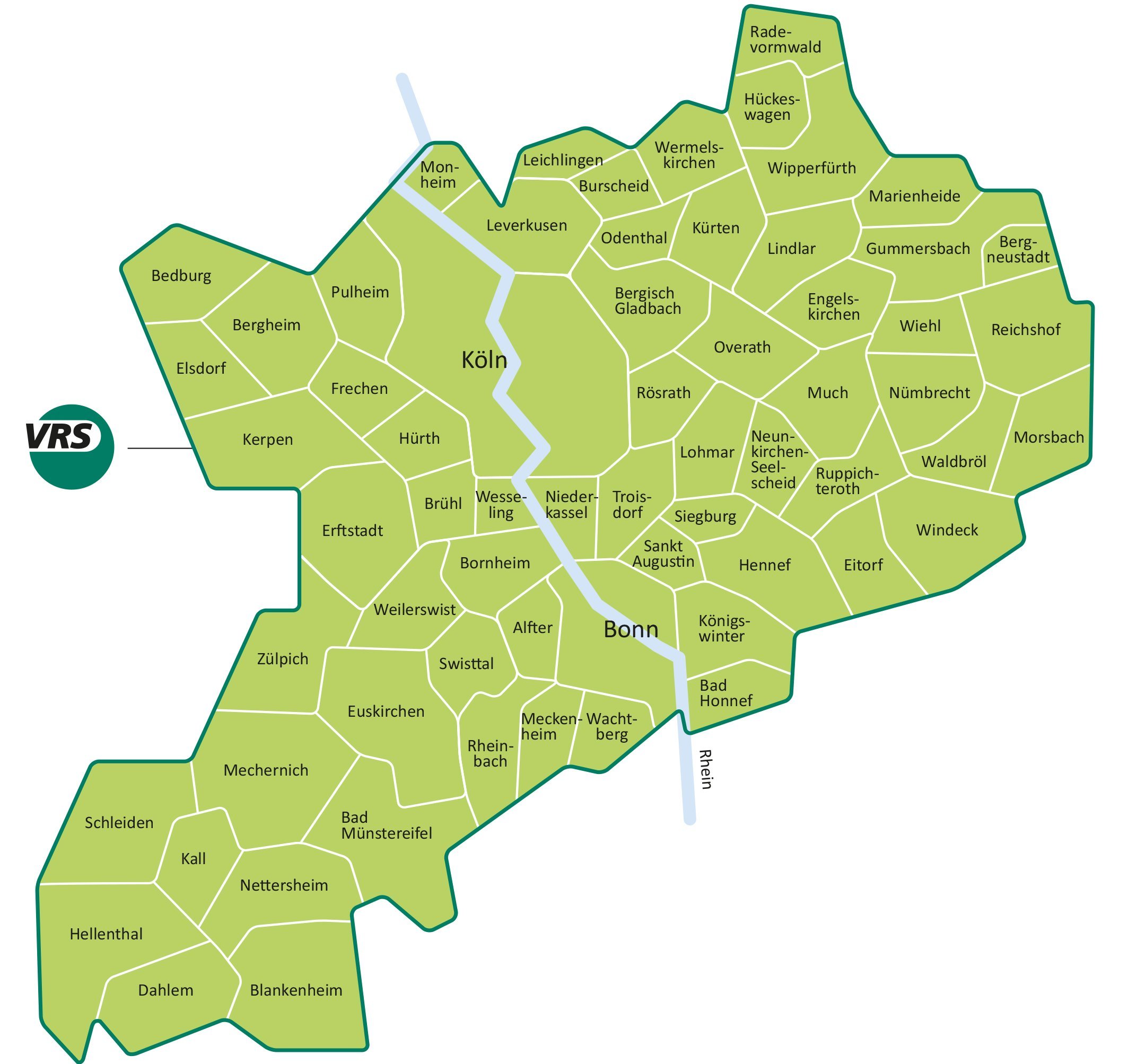
In 1987, the cities of Cologne, Bonn, Leverkusen and Monheim and the districts of Rhein-Erft-Kreis, Rhein-Sieg-Kreis, Rheinisch-Bergischer Kreis and Oberbergischer Kreis joined forces to form the Rhein-Sieg Transport Association. The district of Euskirchen has also been a member since 1996.
Status: April 2024 -
-
The cities and districts that are members of the VRS send their representatives to the Association Assembly of the Zweckverband VRS (ZV VRS) as a political body.
The members of the association assemblies are grouped into political groups, the numerical composition of which is determined by the results of the local elections.
Responsibility for the tasks of the special-purpose association lies with the chairman of the association. The special-purpose association itself does not have any staff, but is wholly owned by VRS GmbH, which carries out its tasks.
-
-
The Verkehrsverbund Rhein-Sieg (VRS) acts as an umbrella organization for the transport companies in the VRS area.
The task of VRS GmbH is, among other things, to adapt and further develop the network tariff in order to provide passengers with uniform tickets and prices as well as coordinated timetables. Joint information and services as well as campaigns are further fields of activity.
You can find more information here:
-
-
The financing of local public transport in Germany is based on two main pillars: tax financing and user financing.
The federal government, federal states and local authorities provide extensive funds from various sources to finance transport services and infrastructure.
The users of public transport make their contribution by purchasing tickets. On average, ticket revenue covers around 75% of the costs in the VRS. The rest is borne by the public sector.
In the VRS, the total expenditure for transport services is almost one billion euros.
-
-
Above all, public transport throughout Germany needs more money.
There are various approaches that could be used to increase funding for local public transport. These include the expansion of parking space management in cities (e.g. higher parking fees, short-term parking, fewer free parking spaces), the introduction of a city toll or financing through levies.
Examples would be a citizen's ticket financed jointly by everyone or so-called beneficiary financing by retailers, employers or property owners who benefit from the existing infrastructure.
However, such instruments require an appropriate legal framework and the political will to shape it.
In addition, it must be ensured that the funds collected explicitly compensate for the reduced user contributions and are not used for other purposes.
-
-
In the VRS, responsibility for business and operational matters lies with the transport companies.
As a rule, they draw up the timetables according to the specifications of the public transport authorities. They operate the routes and are the direct point of contact for passengers.
Where public transport authorities award transport services in competition, they increasingly assume the risk of income from fare revenues in so-called gross contracts. In the case of net contracts or self-service routes, the risk of revenue remains solely with the transport companies.
-
-
They are subsidiaries of the respective municipality and operate on its behalf.
These include, for example, Kölner Verkehrs-Betriebe AG (KVB), Stadtwerke Bonn (SWB) and Rhein-Erft-Verkehrsgesellschaft (REVG).
In the cities, districts and municipalities, the companies implement the transport policy and increasingly the climate policy requirements of the local authorities.
The highly mobile population groups are also strongly represented in the centers. However, the correspondingly high quality of service is far from being able to cover costs. Transport companies therefore find themselves in a difficult area of conflict: they are expected to provide comprehensive mobility services at the most attractive fares possible while at the same time limiting the deficit, which has to be offset via the municipal budget.
-
-
In the regional rail network of go.Rheinland (the cooperation area of go.Rheinland covers the areas of the Aachener Verkehrsverbund (AVV) and the Verkehrsverbund Rhein-Sieg (VRS)) with a route length of 1640 kilometers, eight regional rail transport companies are currently in operation:
- DB Regio AG Region NRW
- National Express Rail GmbH (NX)
- Trans Regio Deutsche Regionalbahn GmbH (Mittelrheinbahn)
- Rurtalbahn GmbH
- Vias GmbH
- Hessische Landesbahn
- Arriva
- SNCB Mobility
On weekdays, they carry more than around 268,000 passengers (442,000 passengers before coronavirus) on the regional express and regional train routes as well as on the Cologne S-Bahn network.
The contracts are awarded by go.Rheinland as part of Europe-wide tenders, as required by EU law. In this competitive tendering process with high quality standards, the transport companies have to calculate carefully and, depending on the contract design, bear the risk of sufficient fare revenues.
-
-
According to the NRW Local Public Transport Act, the independent cities and districts are responsible for general local public transport.
They are responsible for planning, organizing and ensuring general local public transport in their area.
To further develop and improve transport services, the districts draw up and regularly update local transport plans.
In order to be able to offer the population good local public transport, the responsible authorities invest their own budget funds as well as subsidies in local public transport services.